

CASE FILE 003
NUCLEAR TEST SURVEILLANCE
Classification: TOP SECRET
Incident Type: Unauthorized Weapons-Test Observation and Data Theft
Suspects: Three unidentified panda operatives
Current Status: Investigation suspended due to conflicting official explanations
THE OPERATION
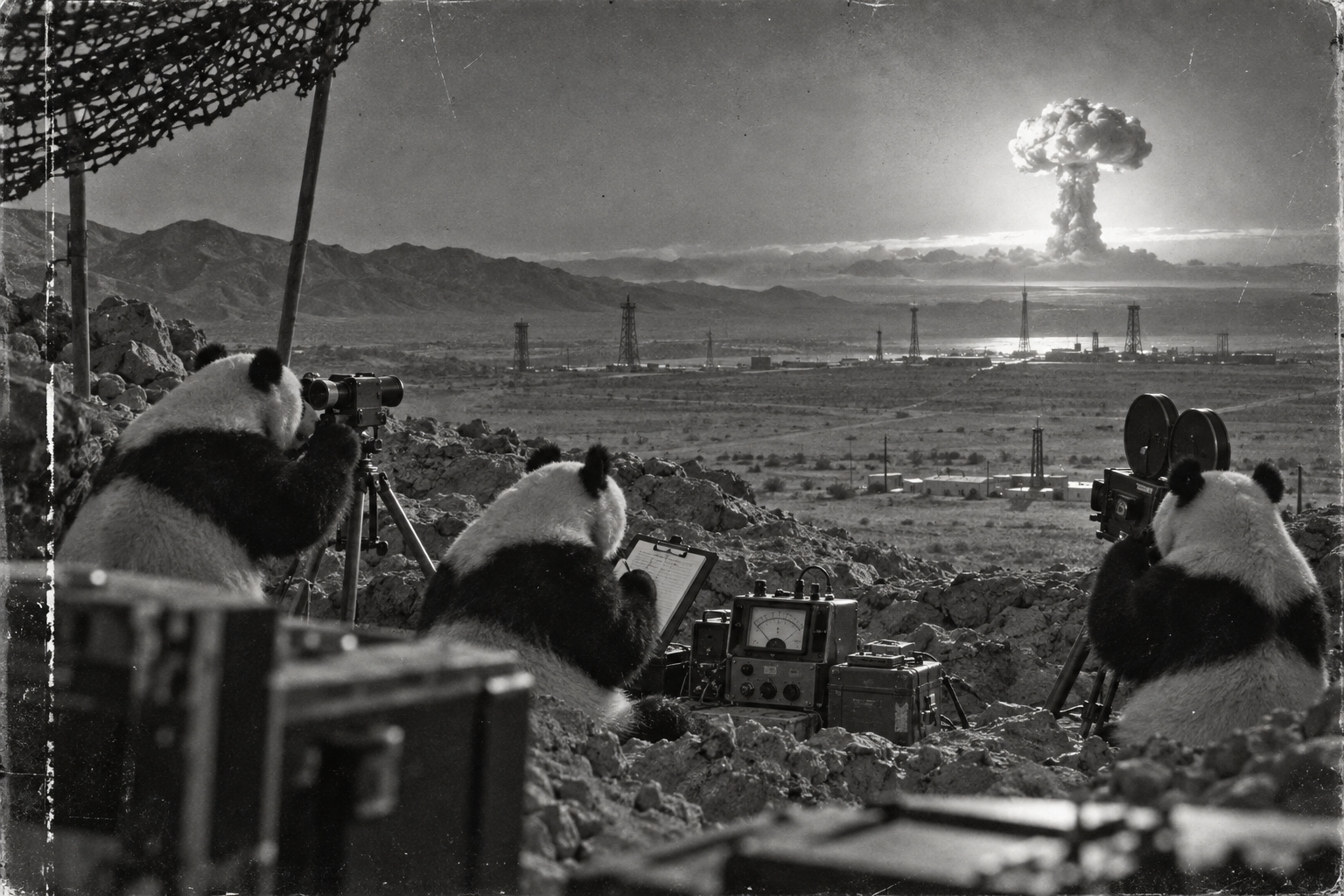
Evidence suggests the suspects reached the observation ridge during the night and constructed a concealed monitoring position behind abandoned military equipment.
Their instruments were aligned with the detonation tower to within one-tenth of a degree. Radiation detectors were calibrated correctly. The motion-picture camera was loaded with high-speed film suitable for recording an atomic flash.
Investigators found no discarded instructions.
This is significant because several newly assigned government technicians required a forty-page manual to operate the same equipment.
One of them still filmed the wrong tower.
At 5:30 a.m., the device detonated.
While authorized observers took cover, the pandas remained at their stations and continued recording. The first tracked the expansion of the blast wave. The second documented radiation levels at precise intervals. The third maintained steady photographic coverage of the rising mushroom cloud.
Film analysis indicates that the camera operator adjusted exposure settings during the detonation.
The government’s official cameraman forgot to remove his lens cap.
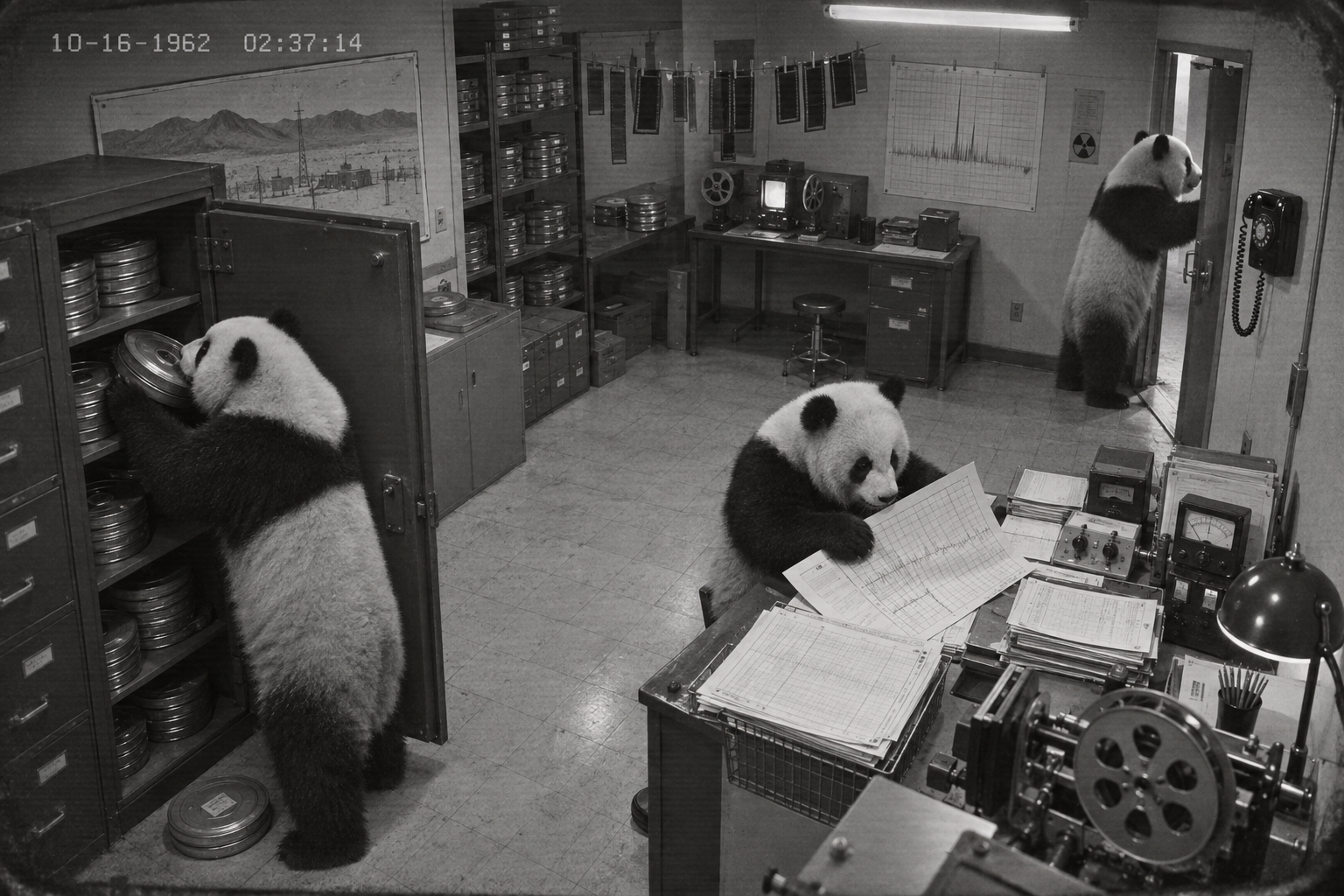
Approximately thirty minutes after the test, the operatives abandoned the observation point and moved directly toward the records facility.
They bypassed two security checkpoints, entered through a locked service door, and located the test-documentation room without searching any other building.
Inside, the suspects removed six film canisters, three radiation logs, and a complete set of blast-pressure readings.
They ignored payroll records, personnel files, and a cabinet containing emergency snack provisions.
Their priorities were technical.
EVIDENCE RECOVERED
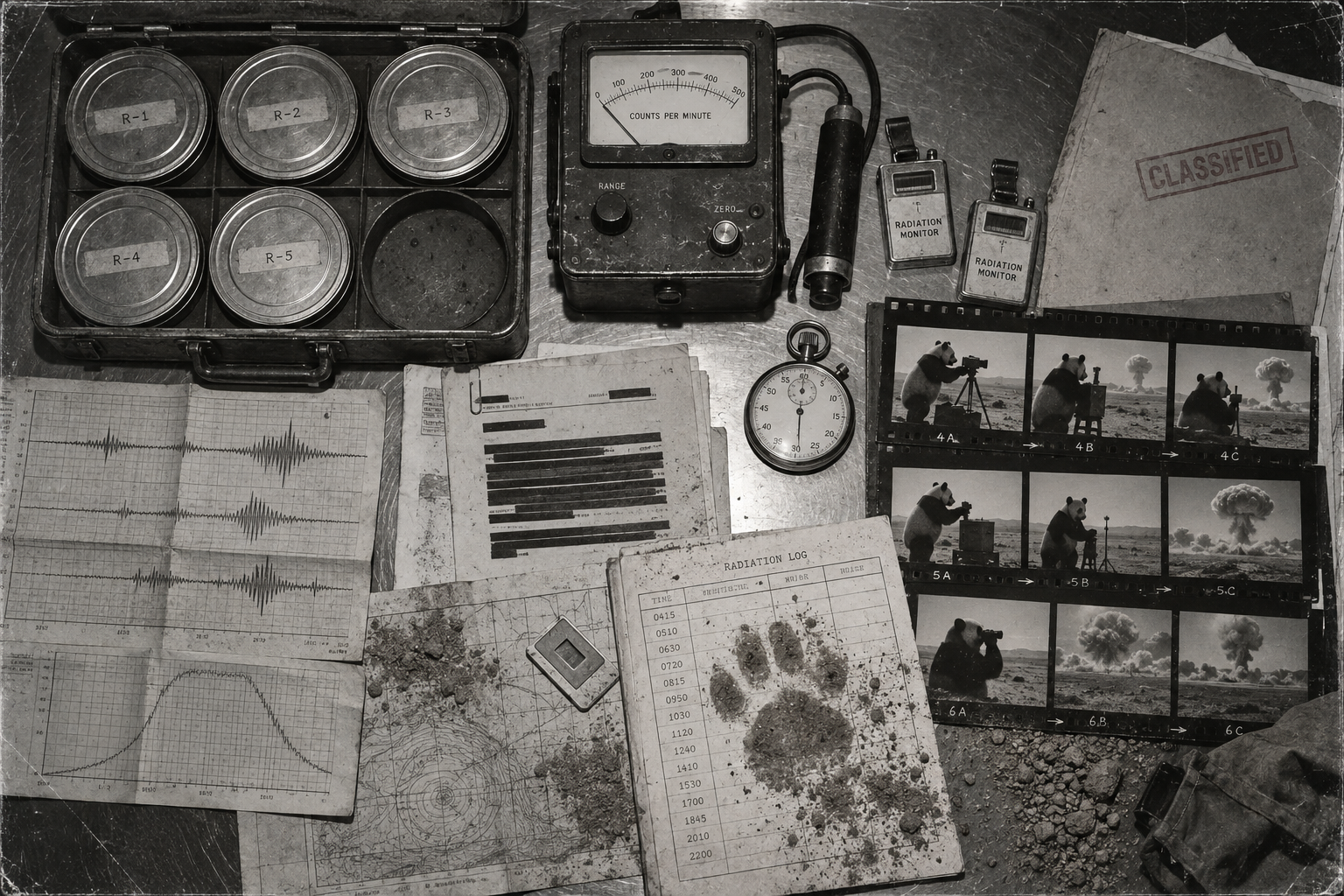
Investigators recovered the following items from the observation ridge and compromised records room:
-
-
- A calibrated optical rangefinder positioned toward ground zero
- A stopwatch stopped at the exact moment of detonation
- Handwritten radiation measurements recorded at thirty-second intervals
- A map marking every government monitoring station surrounding the test site
- Multiple oversized paw impressions in the desert soil
- Two dosimeter badges registered under nonexistent employee identification numbers
- An empty space in a secured carrier designed for classified film
- A mathematical projection of the blast radius completed before the weapon was detonated
-
The projection was later compared with the government’s official calculations.
The pandas’ estimate was more accurate.
A review panel questioned whether an animal could understand nuclear physics.
The panel did not question the math.
OFFICIAL EXPLANATION
Government representatives deny that foreign operatives observed the test or removed classified material.
The official report describes the incident as an “incidental wildlife presence occurring near routine geological research.”
When asked whether routine geological research normally produces a mushroom cloud visible from three states, officials declined to elaborate.
A military spokesperson stated that the photographed pandas were likely cardboard targets placed near the test range to measure blast effects.
When shown images of the targets operating cameras, examining charts and leaving the facility with film canisters, the spokesperson suggested that heat distortion may have created the appearance of movement.
The photographs were taken before the explosion.
The explanation was retained.
Officials later announced that all test records had been successfully accounted for.
Six film canisters remain missing.
Apparently, this is what successfully accounted for means.
ASSESSMENT
The intended use of the stolen information remains unknown.
Analysts believe the operatives were studying weapon yield, radiation dispersal, and blast-wave behavior. The precision of their equipment suggests the mission had been planned well in advance.
More concerning is the possibility that this was not their first observation.
A review of earlier nuclear-test photographs revealed unidentified black-and-white shapes near several monitoring stations. These images had previously been dismissed as equipment bags, damaged signs, or unusually symmetrical rocks.
One of the rocks appears to be holding a clipboard.
Investigators have also discovered unexplained corrections written in the margins of multiple classified radiation reports. In each instance, the corrected figures were later proven accurate.
No government employee has claimed responsibility.
The handwriting is unusually large.
Citizens are advised to report any panda observed near military test ranges, radiation-monitoring stations, film laboratories, or elevated terrain with an unobstructed view of government activity.
Do not approach a suspected operative.
Do not attempt to confiscate its equipment.
Most importantly, do not allow it to review your calculations.
It may find something.
Remember:
A panda watching an explosion may be curious.
A panda measuring the explosion is conducting surveillance.
A panda whose measurements are more accurate than the government’s has become a strategic concern.
CASE STATUS: OPEN
TEST RECORDS RECOVERED: INCOMPLETE
RESTRICTED FILM CANISTERS MISSING: SIX
ESTIMATED NUMBER OF OBSERVED TESTS: UNKNOWN
LOCATION OF PANDA OPERATIVES: UNDETERMINED