

CASE FILE 002
RECOVERED CRAFT INFILTRATION
Classification: TOP SECRET
Incident Type: Unauthorized Access and Biological Sample Extraction
Suspects: Three unidentified panda agents
Current Status: Officially dismissed as an equipment-accounting discrepancy
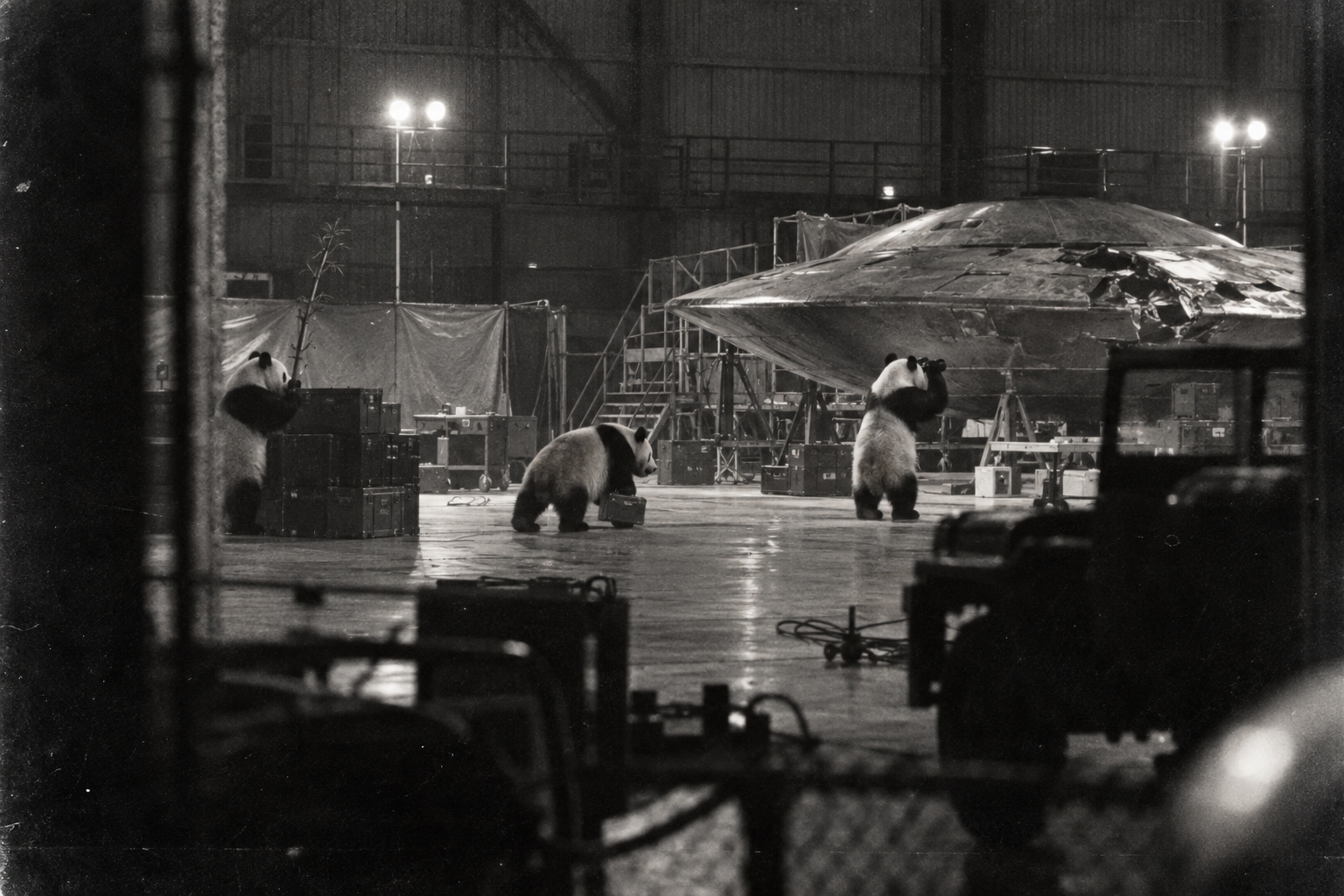
THE OPERATION
Evidence suggests the agents entered through a maintenance corridor during a nine-minute interruption in the facility’s electrical supply.
The interruption affected every security system inside the installation except the cameras recording the pandas.
No explanation has been provided for this unusually helpful failure.
Once inside, the suspects ignored the propulsion laboratory, weapons-analysis division, and hangar control room. They proceeded directly to the biological examination bay without consulting signs, maps, or government personnel.
Their route included six unmarked corridors, two secured elevators and a door disguised as a janitorial closet.
Several employees had worked at the installation for years without discovering the door.
The pandas found it immediately.
Inside the examination bay, the first operative opened a refrigerated containment cabinet and removed four specimen vials recovered from the aircraft. The second inspected each sample against the light before selecting three for extraction. The fourth vial was deliberately returned to storage.
This behavior suggests the suspects were not simply collecting biological material.
They knew which material they wanted.
The third operative remained at the entrance, watching the corridor with sufficient intensity to make two approaching security officers independently decide that they had forgotten something elsewhere.
At 1:51 a.m., the agents left the laboratory carrying three samples and several pages of handwritten research notes.
The entire operation lasted nine minutes.
During the preceding six months, the government research team had been unable to determine what the samples contained.
The pandas required less than four.
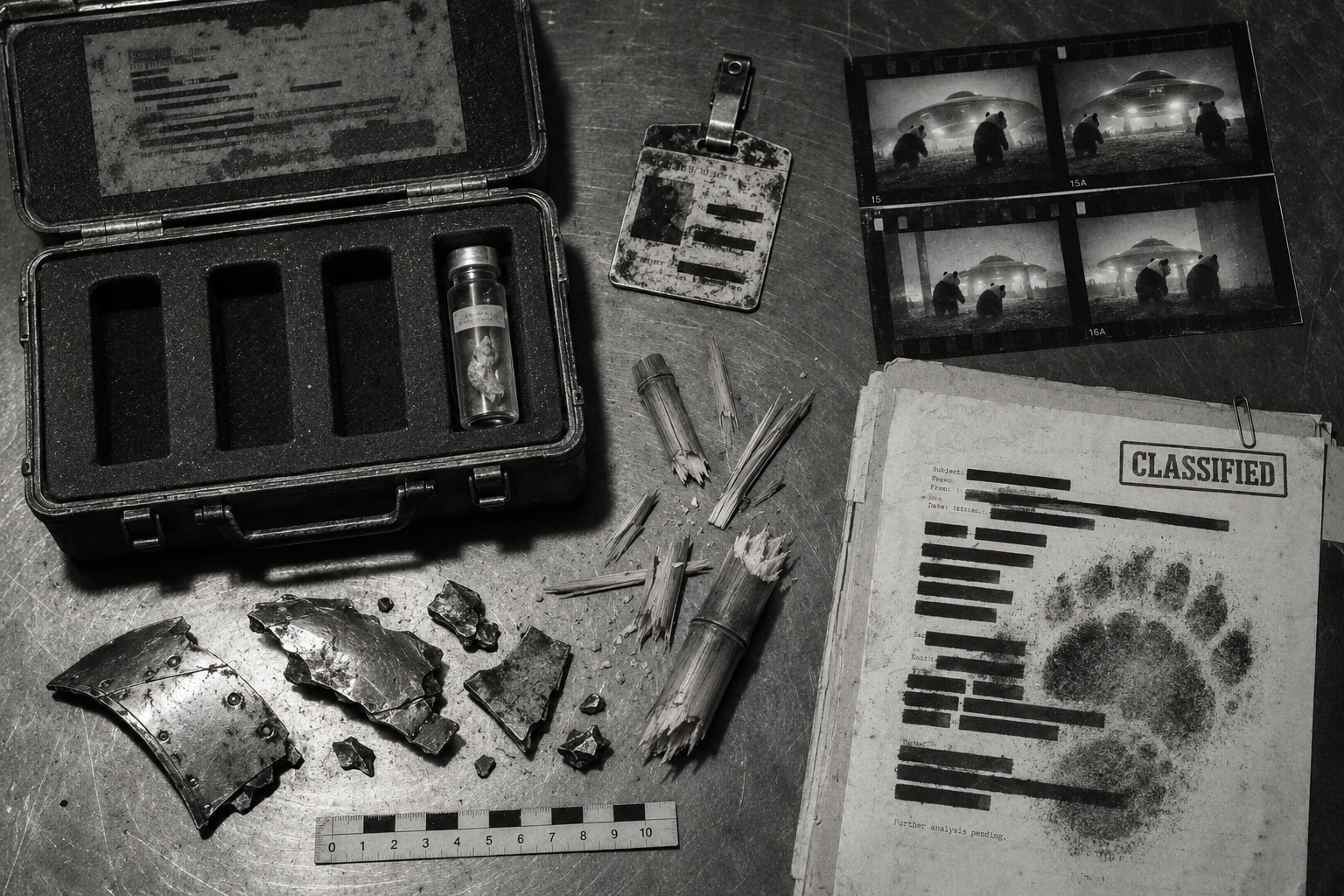
EVIDENCE RECOVERED
Investigators recovered the following items inside the compromised examination area:
-
-
- A damaged laboratory access badge belonging to a scientist who had retired in 1958
- Three empty spaces inside a fitted biological transport case
- Several unidentified metallic fragments removed from the craft’s interior
- One sealed specimen vial deliberately left behind
- A pair of laboratory tongs wiped clean of all identifiable prints
- Oversized paw impressions surrounding the primary containment cabinet
- A handwritten formula that none of the facility’s physicists could interpret
- One government security photograph turned facedown on the floor
-
The abandoned specimen was subjected to immediate laboratory analysis.
Researchers determined that it contained proteins not found in any known terrestrial organism, a cellular structure that appeared to reorganize itself when observed, and a chemical compound capable of temporarily reversing gravity in objects weighing less than fourteen ounces.
The official laboratory report described these findings as “probably mold.”
The report was signed eleven minutes after the sample disappeared.
OFFICIAL EXPLANATION
Government representatives deny that the installation contains an unidentified aircraft, extraterrestrial biological material or any pandas employed by a foreign intelligence service.
The official report describes the incident as an “inventory discrepancy caused by unauthorized wildlife activity inside a decommissioned meteorological storage facility.”
When asked why a meteorological storage facility contained surgical instruments, refrigerated specimen cabinets and an aircraft constructed from an unknown metal, officials declined to elaborate.
They did confirm that the object was not extraterrestrial.
They also confirmed that the object did not officially exist.
Both statements were delivered without clarification.
A military spokesperson later suggested that the photographed animals may have been unusually large raccoons distorted by the camera lens.
The spokesperson was shown the photographs.
The statement was not withdrawn.
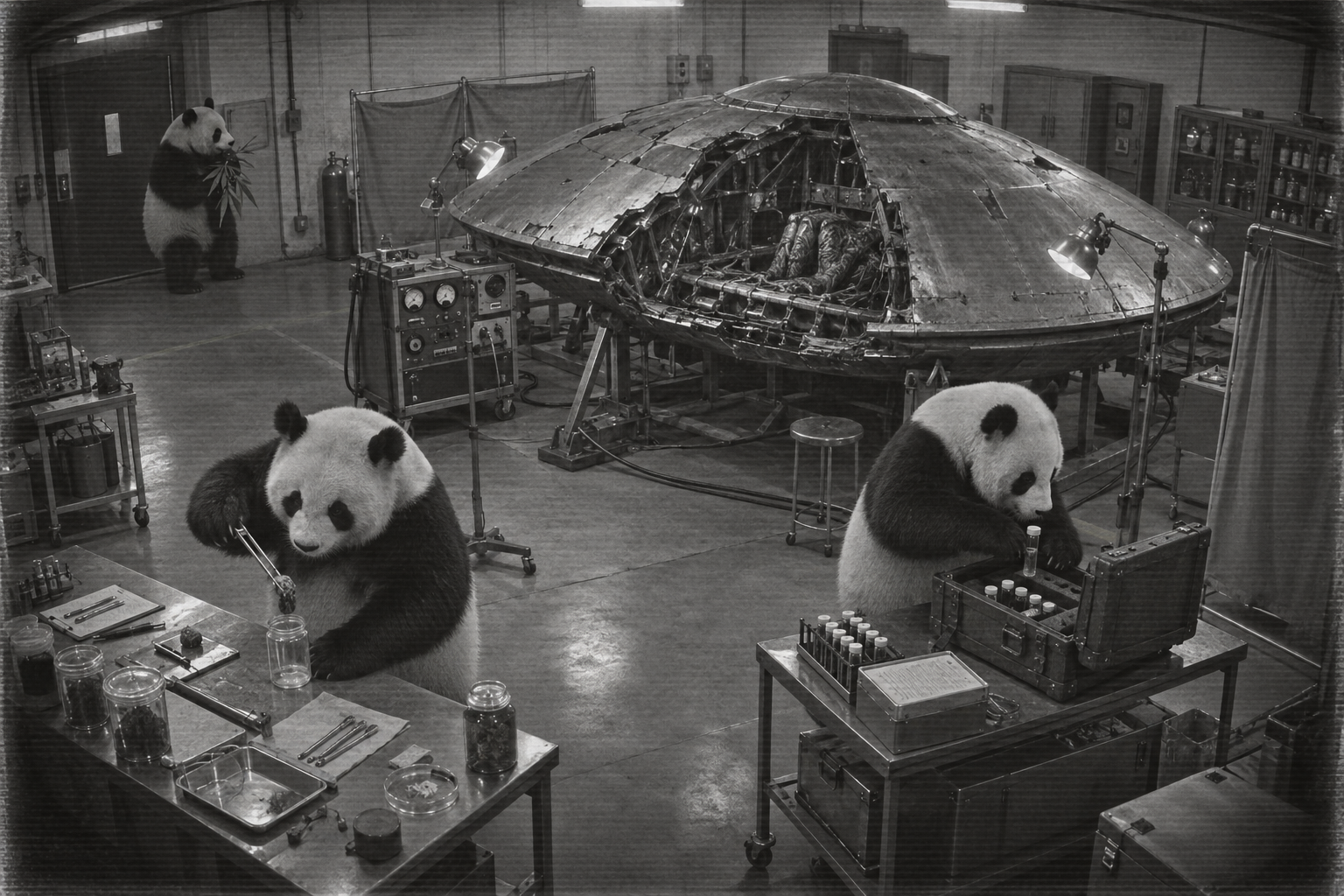
ASSESSMENT
The purpose of the stolen biological material remains unknown.
Analysts believe the panda agents may be attempting to study, reproduce, or neutralize whatever was recovered from the unidentified craft. A more troubling assessment suggests that the samples were not stolen for research.
They may have been retrieved.
Facility records indicate that the recovered aircraft had been held in government custody for seventeen years before the infiltration. During that time, American scientists failed to activate its propulsion system, identify its construction material, or determine the purpose of several controls inside the cockpit.
One surveillance photograph appears to show a panda approaching the craft and activating an exterior panel on the first attempt.
The panel had no visible handle.
Citizens are advised to report any panda observed near military installations, aerospace laboratories, radio telescopes, or unusually well-secured janitorial closets.
Do not assume an animal is harmless merely because it appears calm, round, or poorly equipped for conventional espionage.
Remember:
A panda outside a zoo is unusual.
A panda inside a classified hangar is concerning.
A panda who understands the recovered aircraft better than the United States government is no longer a wildlife issue.
CASE STATUS: OPEN
CRAFT STATUS: OFFICIALLY NONEXISTENT
BIOLOGICAL SAMPLES RECOVERED: ONE OF FOUR
PURPOSE OF SAMPLE EXTRACTION: UNKNOWN
LOCATION OF PANDA AGENTS: CLASSIFIED